There are three main tree removal methods: felling the tree in one piece, taking it down in sections with a climber or lift, and lifting sections out with a crane. Rigging, the rope systems that lower cut wood under control, ties the last two together. When Parker Tree Service plans a removal, the site picks the method: a spruce standing in an open pasture and the same spruce in a fenced backyard are different jobs.
If you’re still deciding whether the tree should come down at all, start with our post on when a tree needs professional removal.
How Arborists Remove Large Trees: The Methods Side by Side
| Method | How it works | Space it needs | Best fit |
| Directional felling | Notch and back cut drop the whole tree in a chosen direction | A clear drop zone longer than the tree is tall | Open lots, acreage, field edges |
| Sectional dismantling | Climber or lift cuts limbs and short trunk pieces that free-drop or are lowered on ropes | A landing area, or a lowering point and room for the ground crew | Most residential lots, including trees over roofs and fences |
| Crane-assisted removal | Sections are cut while slung to a crane, then lifted to a landing zone | A stable setup spot for the crane and its outriggers | Dead or decayed trees, no safe landing area, tight access |
Felling: The Fastest Method When There’s Room
The sawyer cuts a notch facing the intended fall line, then a back cut from the opposite side. The wood left between them is the hinge, and the hinge steers the tree. Cut through it, and the tree goes wherever its weight and the wind decide.
What a Good Felling Cut Controls
- Notch angle. An open-face notch (roughly 70 degrees or wider) keeps the hinge working longer as the tree falls.
- Hinge. Too thin and it breaks early. Uneven and it pulls the tree off line.
- Lean and weight. Heavy side limbs and wind fight the notch. Wedges or a pull line set high in the tree counter the back lean.
- Drop zone. Bystanders stay at least two tree lengths away, and the sawyer’s escape path is planned before the first cut.
The hinge needs sound wood. Internal decay or a split can make it fail unpredictably, so a crew should check for conks, cavities and cracks first.
Sectional Tree Removal: Taking a Tree Down Piece by Piece
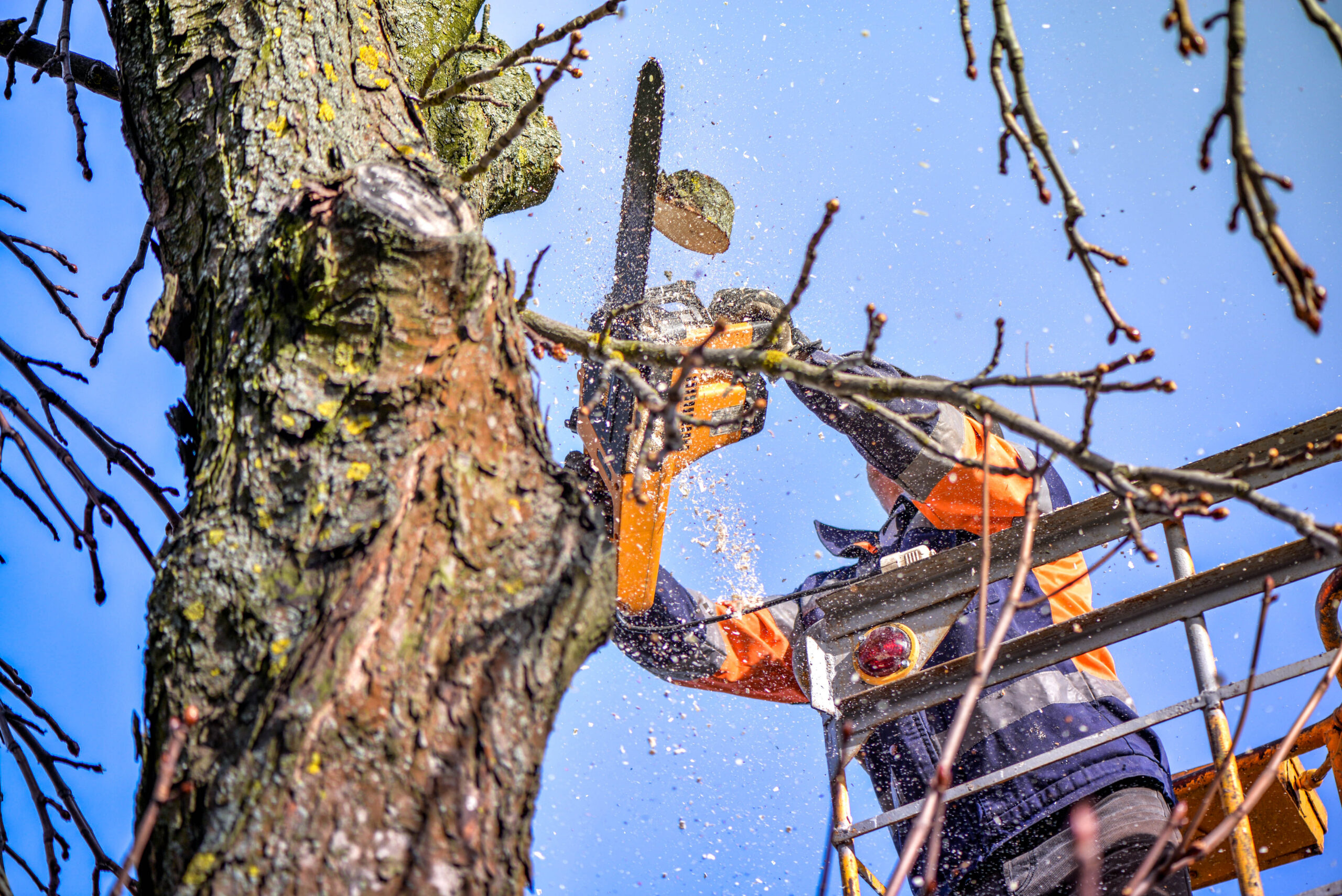
Most residential removals are sectional. A climber on a rope system, or an operator in a lift, removes the limbs, then cuts the trunk in short rounds until only a low stem remains. Where there’s open lawn below, limbs and short pieces free-drop: the climber calls each cut and the ground crew clears the landing zone. Pieces stay short, because a heavy log can still crack sprinkler heads and rut turf.
Tree Rigging Removal: Lowering Wood Under Control
When something worth protecting sits under the tree, the wood comes down on ropes instead of falling.
The Parts of a Rigging System
- Rigging point. A block (pulley) high in the tree, or a strong natural crotch, carries the lowering line.
- Friction device. A lowering device anchored at the trunk base lets a ground worker run line under control and stop a load smoothly.
- Load ratings. Every rope, sling and block has a working load limit. Gear is sized for shock, because a piece that drops before the rope catches it hits the system far harder than its resting weight.
- Specialty setups. Tip-tied limbs come down horizontally to stay off a roof. A speedline (a tensioned line, like a zip line) carries pieces across a yard to the chipper.
Field Note: The tree is part of the rigging system. Every load lowered through a block pulls on the stem it hangs from, so decay near the rigging point means changing the plan instead of pushing through. Check the stem and any union just below the block closely, because that section carries every rigging load.
Crane Tree Removal: When Lifting Beats Lowering
A crane changes the job from lowering wood to lifting it away. A climber or lift operator slings a section, the crane takes the weight, and only then is the cut made. The piece swings over the house to a landing zone near the chipper.
When a Crane Is the Right Call
- The tree is too dead or decayed to climb or rig off safely.
- There is no landing zone: the canopy covers a house, pool or garage on every side.
- A storm-broken or leaning stem can’t take rigging loads.
What Crane Work Requires
A crane’s capacity drops as the boom reaches farther out, so the setup spot limits how big each piece can be. The crew estimates every pick’s weight from diameter, length and species before cutting. The crane needs firm, level ground for its outriggers, clearance from power lines, and a qualified operator working from the load chart. A crane also brings its own scheduling, setup time and sometimes a street permit, so it’s chosen when it’s safer or more efficient, not by default.
| The Messy Middle: The Crane Can’t Get Close to a Backyard Tree Backyard trees boxed in by houses often need a crane most and are hardest to reach with one. Septic fields, irrigation lines and soft lawns can rule out a yard setup. From the street, the boom reaches over the house, and its capacity at that radius may be a fraction of what it lifts close in. A good crew works within those limits instead of fighting them. It plans smaller picks, which means more cuts and more lifts. It rigs the limbs down first so the crane handles only trunk sections. If the crane has to sit in the street, the crew clears the setup with the city before the workday, plans traffic control, and tells the homeowner how long the street will be partly blocked. |
How a Crew Chooses Between Tree Removal Methods
| If… | Then… |
| The tree is sound and has open ground longer than its height on one side | Directional felling is usually the quickest and simplest option. |
| The tree is sound but hemmed in by a roof, fence or beds | Sectional dismantling: free drops where there’s room, rigging over anything breakable. |
| The tree is dead, hollow or storm-damaged over a target | Plan for a crane or lift so no one climbs or rigs off compromised wood. |
| A broken tree is on or against the house right now | Call for around-the-clock emergency tree service and keep everyone out of that side of the house. |
Whatever method takes the tree down, the stump is a separate step. Our stump grinding service handles that once the tree is down.
The Bottom Line
- Felling needs a clear drop zone longer than the tree’s height and a sound trunk.
- Sectional removal fits most residential lots. Rigging adds the control needed over roofs and fences.
- Crane removal fits dead, decayed or unreachable trees. Piece size depends on where the crane can set up.
- Many jobs combine methods: limbs rigged, trunk felled or lifted.
Have an ISA Certified Arborist Choose the Method
The right method is a site decision. On a site visit, we look at the tree’s condition, what’s underneath and how equipment can reach it, then write the method into your free estimate. Read more about our professional tree removal service, or have an arborist choose your removal method.
About the Author
Parker Tree Service is a family-run tree care company founded in 1937 by George “Brownie” Parker. Justin Parker manages the Treasure Valley business from Caldwell, Idaho, and the team includes ISA Certified Arborists. The company is licensed, bonded, and insured (Licensed Contractor RCE #26718).
Years in the industry: In business since 1937.
Technical focus for this guide: Removal planning: directional felling, sectional dismantling, rigging systems, and crane-assisted removal.
Professional profile: Parker Tree Service company history and team