
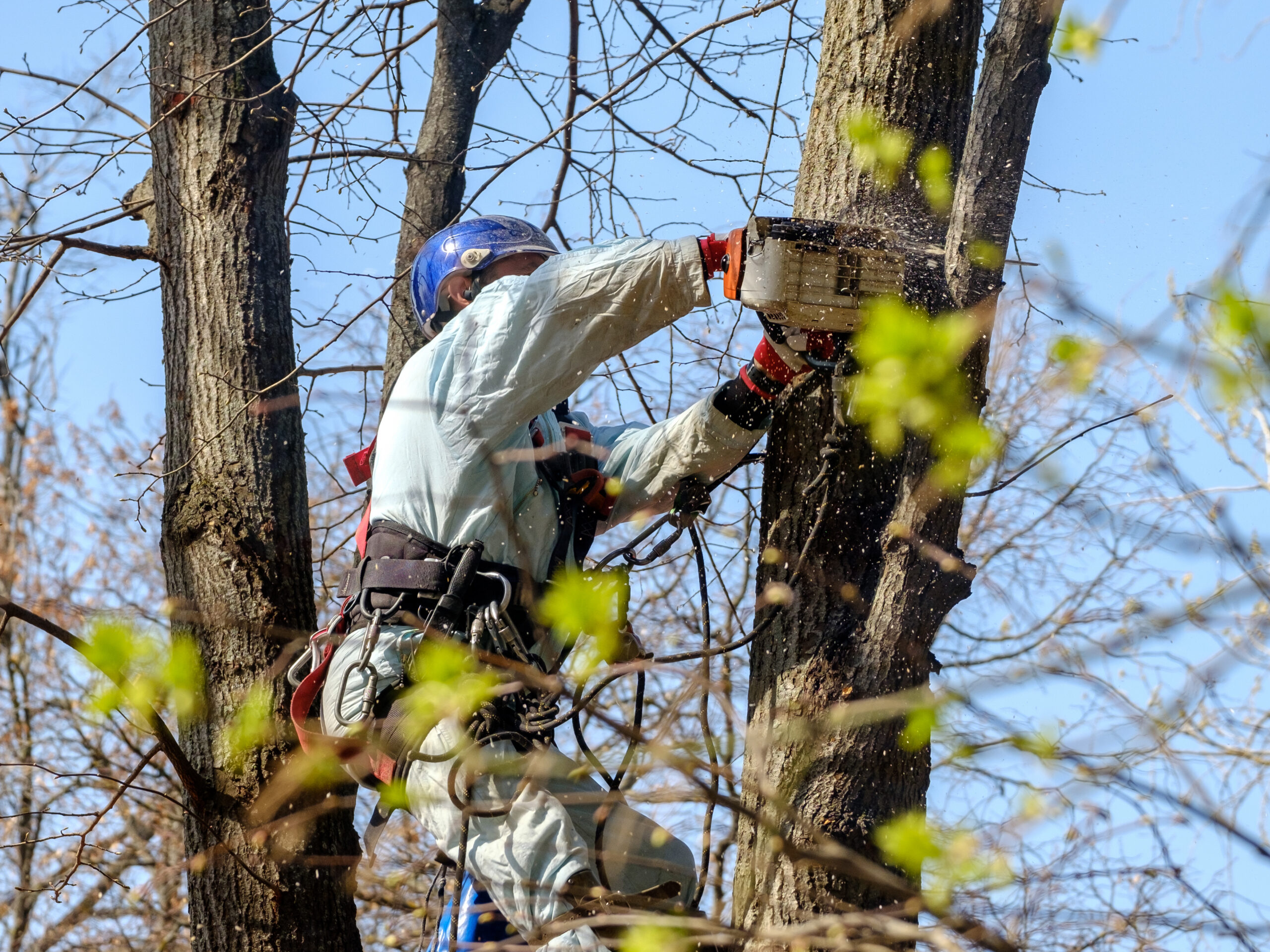
HOA tree maintenance stops being a string of surprises when the board treats common-area trees like roofs, fences and irrigation: assets with a known count, a known condition and a scheduled service interval. At Parker Tree Service, we recommend boards build that plan in four steps: inventory the trees, sort them by risk, prune on a rotation and turn the rotation into a yearly work schedule.
This guide is for board members, community managers and landscape committees across the Treasure Valley. It starts with an HOA tree inventory, because every later decision about what gets done, where and when depends on knowing what the association owns.
Start With an HOA Tree Inventory of Every Common-Area Tree
You can’t schedule work on trees nobody has counted. A tree inventory is a spreadsheet or map of every tree the association is responsible for: entrances, parks, greenbelts, pond edges and common walkways.
What a Usable Inventory Records
- Location: a map point or GPS coordinate, plus the nearest landmark (lot line, pathway, pond edge).
- Species and size: species name and trunk diameter at breast height (DBH, measured 4.5 feet above grade).
- Condition: deadwood, cracks, cavities, decay, dieback and past pruning damage.
- Targets: what a failed limb would hit: a playground, parking, a house, a path.
- Recommended work and priority: prune, monitor, treat or remove, and how soon.
Our tree inventory and management page explains how that work is scoped. Whoever does it, insist on a format the next board can update without the original contractor.
Sort Common-Area Trees Into Risk Tiers
An inventory becomes a plan when every tree gets a priority. Arborists who hold the ISA Tree Risk Assessment Qualification (TRAQ) assess risk by combining the likelihood a part fails, the likelihood it hits something, and the consequences if it does. The categories are low, moderate, high and extreme, so a dead branch over a pond ranks far lower than the same branch over a tot lot. A formal tree risk assessment gives the board a defensible record of why it prioritized work the way it did.
| Tier | What usually lands here | Typical response |
| 1: Act now | High or extreme risk over playgrounds, paths, parking or homes | Remove the defect or the tree promptly |
| 2: Scheduled work | Moderate risk, clearance problems, heavy deadwood | Prune this year, even if outside the rotation zone |
| 3: Routine care | Low risk, healthy trees needing structure or cleaning | Prune on the normal rotation |
| 4: Monitor | Low-target areas, minor issues worth watching | Re-inspect next cycle; no work scheduled this year |
If your board is still deciding whether a formal assessment is worth doing, we laid out the reasoning for why tree risk assessments matter.
Build an HOA Tree Trimming Schedule on a 3 to 5 Year Rotation
Pruning every tree every year is more work than most healthy trees need. Pruning nothing until something breaks turns the plan into a string of emergency calls. The middle path is a rotation: divide the community into zones and prune one zone per year. On a four-year rotation, each established tree gets a visit every fourth year, and the yearly workload stays close to level. Young trees need light structural pruning more often than mature ones, so many plans keep them on their own shorter cycle.
Setting Up the Zones
- Group by geography so crews aren’t driving between far corners of the subdivision.
- Balance zones by tree size, not just count. Ten large cottonwoods along a canal can take more crew time than forty young lindens.
- Schedule zone work for the dormant season, roughly November through February, when crews are easier to book and frozen ground helps protect turf.
Pro Tip: Write “all pruning per ANSI A300 standards; no topping” into the scope of every estimate request. It makes every contractor scope the same quality of work, and it protects the trees from crews who shorten canopies by cutting branches to stubs.
| The Messy Middle: When a Storm Blows Up the RotationA rotation works until a windstorm breaks limbs in a zone that isn’t due for three years. If the board pulls the scheduled crew days to handle the cleanup, the scheduled zone gets pushed, the next one slides, and the plan collapses back into reacting to problems.The fix is to plan storm response as its own track, separate from the rotation. Decide ahead of time who on the board or management team can approve emergency work, keep an emergency tree service contact on file, and have an arborist walk the affected areas after the storm so hazards over paths and homes are handled first.Once the hazards are cleared, record the storm work in the inventory and keep the rotation on its original dates. If a damaged tree needs follow-up pruning, move it into Tier 2 for this year. Either way, the scheduled zone still gets pruned. |
Turn the Plan Into an Annual Work Schedule
With an inventory, tiers and zones in hand, next year’s work list writes itself. Bring it to the board’s annual planning meeting so the work can be approved and booked early.
| Work item | How to plan it | When to schedule it |
| Tier 1 hazard work | Trees flagged for prompt removal or defect pruning | As soon as approved; don’t hold for the rotation |
| Rotation pruning | Trees in this year’s zone, grouped by size class | Dormant season, roughly November through February |
| Tier 2 pruning | Moderate-risk and clearance trees outside the zone | Alongside the zone work, in the same visit if possible |
| Stump grinding | Stumps left by removals, with 811 locates first | After removals, before spring irrigation start-up |
| Re-inspection | Tier 1 and 2 trees, plus any tree flagged after a storm | Once a year, and after major wind or snow events |
| Plant health care | High-value trees flagged for treatment | In each treatment’s recommended timing window |
| Storm response | A plan, a contact list and an approval path | Ready before winter storms arrive |
Scheduling a whole zone in one visit is more efficient than scattered single-tree calls, because crews set up once and chip and haul once. Ask contractors to scope the zone the same way, by tree count, size class and the same ANSI A300 pruning language, so their written estimates line up.
Keep Records the Next Board Can Use
Board members and managers change. Update the inventory after every visit: what was done, the date, who did it and what the arborist recommended next. Keep written estimates, risk assessment reports and completion notes in one shared folder. A new board should be able to open it and see exactly where the rotation stands.
How Boards Should Set Priorities When Plans Change
| If… | Then… |
| The association has never inventoried its trees | Do the inventory first. Every later decision depends on it. |
| The year’s work has to shrink | Keep Tier 1 work, shrink the rotation zone and defer cosmetic pruning. Don’t defer risk. |
| A storm damages trees outside this year’s zone | Clear hazards first under the storm plan, then keep the rotation on schedule. |
| One species makes up a large share of the canopy | Phase replacements over several years so a pest or decline doesn’t hit all of them at once. |
| Two written estimates describe different work | Compare scope line by line: tree count, ANSI A300 language, stump grinding, cleanup and haul-away. |
The Bottom Line
- An HOA tree inventory comes first. Four risk tiers then decide what gets done this year.
- A 3 to 5-year pruning rotation keeps the yearly workload close to level.
- Plan storm response separately so it doesn’t push the scheduled zone.
- Schedule rotation pruning for the dormant season and keep records the next board can use.
Plan Next Year’s Tree Work With an ISA Certified Arborist
A site walk before your annual planning meeting gives the board a real tree count and a priority list. Our ISA Certified Arborists work with associations and property managers across the Treasure Valley through our commercial tree services. Book a common-area site walk with your manager or landscape committee.
About the Author
Parker Tree Service is a family-run tree care company founded in 1937 by George “Brownie” Parker. Justin Parker manages the Treasure Valley business from Caldwell, Idaho, and the team includes ISA Certified Arborists. The company is licensed, bonded and insured (Licensed Contractor RCE #26718).
Years in the industry: In business since 1937.
Technical focus for this guide: Common-area tree inventories, risk tiers, pruning rotations and annual work scheduling for HOAs and community managers.
Professional profile: Parker Tree Service company history and team